Sunday, June 7, 2020

SKYLAB 2: THE MOST DANGEROUS AND DARING EVA EVER


You can get it on e-book
Here
Or get an autographed and
personalized copy HERE
 The following is an excerpt from my book “Growing up with Spaceflight- Skylab/ASTP.” This material is copyright 2014 Wes Oleszewski and my not be reproduced without the express permission of the author. 


“This will be the most dangerous and daring EVA ever attempted!” one TV “journalist” spouted during the July 2005 STS-114 Space Shuttle mission. It was then that astronaut Stephen Robinson was scheduled to ride out on the Shuttle’s Remote Manipulator arm so he could pluck out a couple of pieces of gap-filler that were protruding from between a few of the orbiter’s tiles with his gloved fingers. In fact, the most daring and dangerous EVA ever attempted, which was done 22 years earlier by Pete Conrad and Joe Kerwin aboard Skylab. Their mission was to deploy the jammed SAS wing number 1 and their task was far more daring and far more critical than that of STS-114, yet it was nearly ignored by the news media of the day.

On the morning of Thursday, June 7, 1973, day 14 of the Skylab 2 mission, Conrad and Kerwin were in the airlock preparing to go EVA and make mankind’s first major repair of a space vehicle in orbit. The airlock hatch was actually a surplus Gemini spacecraft hatch that had been adapted for used on Skylab. After all, it was flight tested, man-rated so re-using it on Skylab would save a lot of time and money and that was a big part of the Skylab mentality; saving nickels and dimes in a multi-billion dollar program. Unfortunately, the process of engineering and adapting a hatch originally designed to conform to a conical hull so that it could later conform to a cylindrical hull ate up a degree of those dimes that had been saved. Still, the hatch was opened and armed with all of the implements needed to execute the “Rusty EVA plan,” Conrad and Kerwin emerged from the workshop into the vacuum of space.

Conrad (left) and Schweikart (right)
in the neutral buoyancy tank before
the SL-2 launch.
Back-up mission commander Rusty Schweickart, both before and after the launch of SL-2, had been working long hours in the Neutral Buoyancy Tank at Huntsville to develop a method by which the crew might be able to deploy the jammed SAS wing. With the aid of TV pictures sent down during the initial fly-around of the workshop as well as descriptions from the crew,  Schweickart had lead the team on the ground and improvised, then later fine-tuned, a method that would eventually lead to the success of deploying the SAS wing and thus saving the entire Skylab project.

Originally, during the initial fly-by of the Skylab 2 CSM, the limb-loppers were supposed to be used by Skylab 2 pilot Paul Weitz to cut completely through the aluminum strap that was thought to be holding the SAS wing down. But his angle to the strap negated that method of using the loppers. Now Schweickart came up with another use for the limb-loppers; they would make a good anchor. The plan was for Kerwin to extend a long pole with the limb-loppers secured to the end out as far as the strap. Next he would use the jaws of the loppers to bite into the strap cutting it about half way through and thus anchor the far end of the pole. Conrad would then move hand-over-hand out along the pole and secure a line onto the far end of the SAS wing. Then he would return along the line and he and Kerwin would move under the line and, with their feet on the workshop, both astronauts would stand up and exert as much pressure as they could on the line. It was felt that such leverage would break the SAS wing loose and allow its solar panels to deploy.

Learning began quickly as Kerwin opened a bag containing some of the ropes that were to be threaded out and used in the operation. Instead of neatly spooling out, the entire bundle of rope simply spring out and burst open in zero-G like a huge tangled web.

Conrad: “I wish you hadn’t pulled that rope outta the bag. Holy Christmas.”

Kerwin: “I gave it one tug and it all came.”

Soon Kerwin got the pole extended without any problem, but getting the jaws of the limb-loppers onto the strap was proving to be impossible. Throughout an entire day pass around the Earth, Kerwin struggled with the 20-foot-long pole, but without any foot restraints every time he moved the pole his body simply torqued away in the opposite direction. Conrad tried to hold onto Kerwin’s ankles and stabilize him, but it was no use. Frustrated, the two men grunted and cussed as the Skylab went in and out of the range of ground stations.


For those of you who grew up in the Space Shuttle, TDRS era with continuous communications between the ground and the spacecraft, it was very different in the Skylab days. Ground stations did all of the receiving and transmitting of communications and telemetry. Thus, the astronauts at work would be in range for three or four minutes and then out of communications for hours. To make matters worse, they were in total darkness on half of every orbit. Their suits were not equipped with lights.

Back on Earth, I was allowed to again take the day off of school. So staying home to monitor this critical EVA was no problem for me. The problem was the actual “monitoring” of the EVA itself. None of the television networks carried anything concerning the event. Considering that just a brief downlink of TV would be sent from the workshop, why bother to interrupt the game shows and soap operas? Once again, the only outlet for those of us outside of NASA to keep track of this critical and dangerous EVA was the top and bottom of the hour news broadcasts on the AM radio. My local station, 1400 WSAM, had NBC’s veteran spaceflight reporter Jay Barbree making the twice-hourly reports. Mixed in with Watergate and other assorted news, Jay’s reports were about 20 seconds long and often included a sound bite with the voices of the astronauts. His name spoken by the news anchor Wilson Hall meant that space stuff was soon to be heard. As the Skylab made that day pass, Jay’s clip had Conrad and Kerwin in an obviously frustrating situation and not doing well. The exchange went like this:


Conrad: "Joe, you got to have it tethered, and it'll slide out let it slide out, it can slide out."

Kerwin: "It's not tethered to what?"

Conrad: "The pole. Let me get it in front of the pole…"

Kerwin: "What are you going to tether the pole to? Oh, yourself, huh?"

Conrad: "No. Now you…"

Kerwin: "Oh! The BET!"

Conrad (in frustration): "I just… No, damn it! I'll tell you what I wanna do. Back…"

Kerwin: "What is that tether you’ve got on there?"
Conrad (with a resigned sigh): "That's the pole tether. Now, if you just stay with me a minute. Come on back with pole, I'll tell you what we’re going to do, we’re going to get it in the right configuration."

Kerwin: "We were in the right configuration…"

Conrad: "No we weren't. We were too short. We couldn't slide your pole back. See? Now the tether will go as far up the pole if you want to. You follow me?"

Kerwin: "Whew.”

In keeping with the media’s coverage of Skylab, that little, frustrated exchange between the two astronauts was repeatedly played through the entire day, even long after the crew had successfully completed their EVA. It was played the following day as well. The actual, jubilant, communications that came after they had succeeded was almost completely ignored.

Joe Kerwin. Note: the tether attached to
his chest, just below his helmet.
Kerwin’s biggest problem was getting his feet anchored. He had told Schweickart the problem was not a hand stability problem, but a foot stability problem. Then as the station was out of communication range, the two astronauts spotted a protruding “U” bolt on the surface of the workshop. They had some extra tethers and quickly cooked up a plan to solve the foot stability problem. They ran the tether through a loop on the front of Kerwin’s suit, pulled it tight and then when he stood up he had a three-point stance. In a matter of minutes he had the lopper anchored to the aluminum strap.


When next the crew came into range of a communications station, Conrad and Kerwin were still wrestling with the umbilicals but had the jaws of the limb lopper in place. That brief period of radio contact had them tangled in the umbilicals and being heavily coached by Rusty Schweickart in Mission Control. Paul Weitz was asking if they wanted him to come out and help. Conrad, however, quickly belayed that idea and things did not look good as the crew passed out of range of the Vanguard tracking ship.

It would be one hour and three minutes before the Skylab would again pass into communications range at Goldstone. The workshop was in its 347th orbit, and in Houston Schweickart and the engineers could only sit and wait. Conrad and Kerwin, however, were very busy.


After getting their umbilicals straightened out, Kerwin steadied the pole while Conrad crawled out along it as far as he could. He fastened the line to the SAS wing where it would do the most good and then came back. Kerwin then fastened the other end to the workshop. As Conrad headed back, the limb-lopper jaws decided to cut all the way through the strap and the huge SAS wing started to rise up with Conrad aboard! The wing, however, stopped at about 18 to 20 degrees up. A “snubber” on the hinge needed to be physically broken in order to fully deploy the wing. So Conrad returned to the area near Kerwin and prepared for the final maneuver. Now both astronauts ducked under the line, and with it over their shoulders they stood up and applied as much force as they could.

Kerwin later recalled that although there was no sound in the airless void of space, he felt a sense of release that would normally be associated with “a loud crack.” The SAS wing broke loose, the line let go and the two astronauts, who had been pushing with all of their strength against the workshop with their feet and the line with their shoulders, were shot into space, in Kerwin’s words, “ass over tea kettle.” Conrad said it was like being shot out of a bow and arrow. Of course both men had umbilical’s secured to the station, so they did not go far.

When each astronaut regained their senses and looked back at the workshop, they saw the SAS wing deployed and the solar panels coming out. This was indeed the most daring and dangerous EVA ever attempted and they had succeeded in a glorious manner.

As the workshop came into range of the Goldstone station, telemetry quickly showed the crew’s success. Power levels for SAS wing 1 were rapidly climbing. As soon as voice was enabled, the two crewmen were heard chattering about the open SAS wing.


"All right,” Conrad reported, “I'll tell you where we are. We've got the wing out and locked, the outboard panel and the middle panel are about out the same amount, and the third one is not quite. Now, Joe, I think before you come in, you better take a look up there and make sure that third one is clear of all the debris."

Communications were regained at one minute after the hour and in just minutes the ears of the space news media picked up the success. With my ears glued to the radio and with my tape recorder at the ready, I had been recording every news break and every shred of Skylab news all day. The word came first from Wilson Hall who was the NBC radio news anchor.

“There’s good news from space,” Hall simply said.

Then he tossed to Jay Barbree who came on and happily reported,

“In a daring difficult spacewalk man has proven that he can repair and save a billion dollar spaceship in earth orbit!”

I let out a “Wahoo!” that ended up on my tape. I knew what this meant to the program as well as to the future, yet I was among the few in the general American public who actually realized the weight of the situation and what had been involved in the repair. I don’t know how many other kids of my age had been following the EVA that day, but I do know that Jay Barbree and NBC radio had been the only source filling me in on that historic event.


Be sure and catch all of the real-time adventure of Skylab by reading my book, "Skylab/ASTP." There is MUCH more and it is indeed a fun ride- you'll feel like you are right there again, or for the first time.


Get the full series HERE
Or get it on e-book HERE


Sunday, May 24, 2020

THE LAUNCH OF SKYLAB 2

Get your copy HERE
Or e-book HERE
The following is an excerpt from my book “Growing up with Spaceflight- Skylab/ASTP.” This material is copyright 2015 Wes Oleszewski and my not be reproduced in any manner without express permission of the author.


Launch for Skylab 2 was scheduled for 9:00 am Eastern time, May 25th, 1973 and that was a bonus for me as a space-buff. First off, I got my usual parental-granted day off from “school” in order to watch and tape record the launch. Secondly, the launch time was not in network TV’s “prime-time,” and it was also not in their “daytime” broadcast period either. In fact, it was on the tail end of their morning news block and this was, indeed, “news.” Thus, there was plenty of coverage and short segments broadcast on all three networks. CBS started snippets of coverage at 7:00 am on their “Morning News” program. ABC started coverage at 8:30. Leading the pack was NBC, where the launch of Skylab 2 nearly took over their entire “Today Show” program at 7:00 am and “live” coverage began at 8:50 am. NBC’s Roy Neal and Jim Hartz ruled the roost that morning as the broadcast showed the efforts being made to save the workshop. It was clear to the news media that the wounded Skylab was sailing into unfriendly political waters. As the “Today Show” turned into nearly a two-hour, pre-launch broadcast, Jim Hartz ended with a profound observation saying,


“More than just the repair and salvage of Skylab is riding on what the astronauts do in the next two days.”


Indeed, at that point in history America’s space program and Skylab were on the downhill slide in support both in Congress and especially the White House. Any failure in the effort to repair Skylab would likely end the entire effort and the public in general would not give a wink.

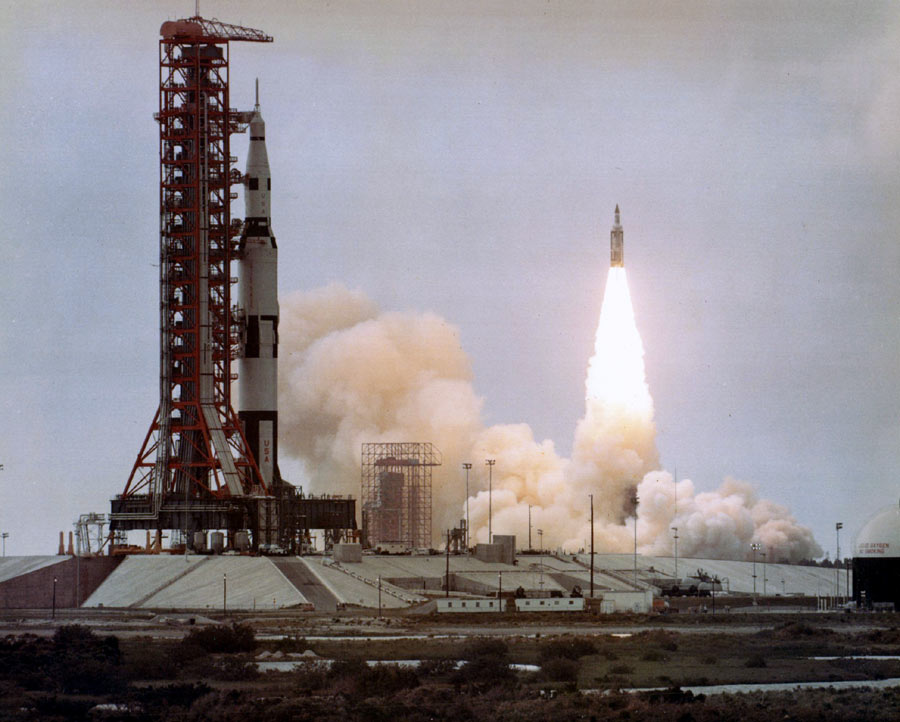
At ignition, Skylab 2 appeared as if it might simply melt away the steel struts of the Milk Stool. Bright yellow-white flames burst through the legs of the giant podium and – unlike all the Saturn Vs, which we had seen held down for nearly nine seconds after ignition – the Saturn IB departed just 3.055 seconds after ignition. Then, a scant 19 seconds after liftoff, AS-206 was swallowed by the overcast. Seven seconds later a range tracking camera picked up the glow of the engine plume and held it for another 18 seconds, and that was the last anyone saw of Skylab 2’s launch. Walter Cronkite commented,

 “…I don’t think ever before has any launch disappeared quite so quickly and quite so completely…” and he was correct.

“Tower, Houston...” Mission commander Pete Conrad was ecstatic in his first call as AS-206 cleared the tower, “...Skylab 2, we fix anything, we got a pitch and a roll program!”


A few seconds later he exclaimed, “Boy is that a smooth ride!”


Being a veteran of the Saturn V boosts, the first stage of which was described as a runaway train wreck, Conrad’s words were a tip of the hat to the von Braun team at the Marshall Space Flight Center who had developed the Saturn I and IB during the early 1960s.


However, after having been in storage for a half-decade, AS-206 produced about 0.88% less thrust than predicted; the exact predicted thrust was 1,642,995 pounds and the actual thrust was 1,628,516 pounds. No matter, the S-IB first stage did its job and then staged nicely to the S-IVB, which burned for a total of 440.4 seconds. That was 2.5 seconds longer than predicted and it placed the Skylab 2 spacecraft into an orbit that was 3.927 miles higher in apogee than planned, but easily corrected.

Much to my delight, NBC news used the early morning launch to fill a bit of air time with a pre-recorded “tour” of Skylab. Spaceflight anchorman Jim Hartz did a 12-minute segment showing viewers nearly every inch of the workshop, as well as many of the devices to be used during the mission. This coverage gave me high hopes for the future mission news coverage which, as time would demonstrate, would never come to pass.


AUTHOR’S NOTE:
         As it turned out, by pure happenstance alone, Pete Conrad was exactly the right astronaut to be commanding that repair mission. Since he was a little kid he had been a hands-on, take-it-apart and fix-it guy to his soul. He loved to do hands-on work, he loved things that were mechanical and needed repair. He was probably a bit tickled that his “pure science” Skylab mission now had this repair mission as a key objective. It was his fix-it moxie that caused him to get under the line that he and Joe Kerwin had attached to that SAS wing, put it over his shoulder and then stand up, forcing it to break the SAS wing loose. That was not something they had trained to do. That was pure Pete Conrad and it saved the entire Skylab program. 

You can get your copy of any or all of the books in the
Growing up with Spaceflight series autographed and
personalized HERE

Or... get them on e-book HERE


Monday, January 27, 2020

APOLLO 1


This blog entry begins with an excerpt from my book, "Apollo Part One" and following that I'm going to give some perspective, so stay tuned.


"APOLLO 1
THE BLIZZARD OF ‘67

Up in the great state of Michigan we were totally unaware of the fever pitch at which the work on Apollo was progressing at Cape Canaveral and at other NASA centers around the country. In fact, on Thursday, January 26th, 1967 we were getting our first taste of a massive blizzard. After local weather broadcasters predicted, “a good amount of snow” we got plenty more than that. My Dad had driven the family car to the railroad depot in Flint about 30 miles south of our house. He was working as a railroad engineer on the “third trick” night shift at the at the Buick Fisher Body plant. This meant that he had spent all night running a switch engine in snow that began to come down far more heavily than predicted. By the end of his shift on Friday morning, the roads were impassable and the snow was coming down even harder.


Dad called home to see if we were all okay and to tell Mom that he was stranded. She was a bit scared- considering that this was the worst snow storm in a half century and she was home with three kids ages 9, 7 and 3. Dad immediately told her that he would get home- somehow.


 Of course we three kids were delighted. The schools were all closed and we watched with endless fascination as the snow blew and drifted. Eventually the drifts got so high that I could stand on a stool, crank open the bedroom window and touch the top of a drift that was right there at window level five and one half feet above the ground. Nothing moved and no one ventured outside all day on Friday the 27th, except for my Dad. The C&O line that he worked for had a freight train that came through Flint from Toledo, Ohio and ran up to Saginaw every morning. Dad hopped aboard the engine on that train and rode it up to the town of Bridgeport. There, the train passed within 100 yards of my paternal Grandma’s house. Dad had them stop there, he hopped off and hiked over the fence and through the drifts to Grandma’s house. She provided him with some warm dry clothes and hot coffee and then he set out, on foot, for our Sheridan Park home a mile and a half away. He had called from Grandma’s house to tell us he was on the way and all three of us kids kept watch out the back windows. After what seemed like hours, he came trudging along the Grand Trunk Railroad tracks behind our house and through the blizzard to our back door. We all cheered as if Santa had arrived; now we would all be snowed-in together.

That evening, as the snow piled up some folks gathered around a warm fireplace. On our side of town, however, almost no one had a fireplace and at our house we all gathered around a warm TV set. It was late in the evening and almost bedtime, we were watching ABC’s local channel 12, and my most favorite show, aside from “Batman” of course, “The Time Tunnel.” Suddenly the program was interrupted by an ABC News “Special Report.” There on the screen in glorious black and white was ABC’s “Science Reporter” Jules Bergman. Hardly looking into the camera Bergman began to read from some papers in his hands. His voice was shaking and cracked at least once- I thought he was actually going to cry, but as I listened to his words I knew why. Most of what I got from what he was reporting was that the three astronauts of the Apollo 1 mission, Gus Grissom, Ed White and Roger Chaffee, had just been killed by a fire on the launch pad at Cape Canaveral. I really did not soak in much more than that. My Mom put her hand over her mouth and gasped and my Dad said nothing. You always knew that something was really bad when my Dad went silent. Before a moment seemed to pass the news bulletin was over and the “Time Tunnel” returned.


Mom put us all to bed that evening but there was too much blizzard going on for me to sleep. I spent a protracted time looking out my bedroom window and watching the snow blow past under the street light. What kept running through my mind was that the astronauts had been killed in a fire at the pad.

“At the pad, how could that happen?” I wondered. “Were they down in the place under the rocket and someone accidentally started the engines?” my nine-year-old brain pondered, “How could NASA let that happen? Didn’t they have their spacesuits on? Aren’t astronauts indestructible?”

I kept picturing three astronauts in spacesuits walking down in the flame trench and then somehow the rocket engines just lit up and incinerated them. It was an awful thought for a kid with a very vivid imagination; almost as awful as the actual event on Pad 34."

Of course there is much more to the story, and you'll have to read the book to find out the rest. 
NOW... the blog part...

As a space buff and spaceflight historian I find that the end of January each year is simply the worst. Not because of the three U.S. manned spaceflight tragedies that took place at that time of the year, but because of the social media ratcheting up of grief over those events. Sure, we all should remember those who were lost, but let us leave it as that. Launch Complex 34, for example is treated like a grave site. It is NOT a grave site where anyone should go to weep. In fact it is a historic landmark where three astronauts were killed in an accident, but it is also the place where huge steps forward in the peaceful exploration of space took place. Certainly, in the middle of that the Apollo 1 fire also took place and three astronauts were killed. Yet we need to keep that within the total context of the history of the site.

On May 5, of 1961 Alan Shepard launched into space on a Redstone booster from the Cape and on July 21 of that same year Gus Grissom also boosted from LC-5, just 8,330 yards from where he would lose his life less than six years later. Americans were thrilled by these two flights which were boasted in the media as being a great leap in our space race with the Soviets. The Soviets, however, were quick to point out that their R-7 boosters were so much more powerful than the Redstone they made the two American space launched look like, "...a flea's jump..."

Soviet propaganda was right, yet was ignoring an American operation that was taking place right out in the open. On the same day that Alan Shepard's Freedom 7 was launched, the SA-1, S-I first stage was in the test stand at MSFC being test fired for the second time. That firing of 44.17 seconds duration produced far more power than the Soviet R-7. Some three weeks after Grissom's Liberty Bell 7 flight, that first Saturn I booster arrived at Cape Canaveral's Launch Complex 34 and was erected on the launch pedestal. It would shake the world on October 27, 1961 when it successfully launched as the world's most powerful booster.


Three more Saturn I vehicles would fly from Complex 34. The Soviets would never catch up in successful listing capability.


On August 18, 1965 the first Saturn IB would begin stacking at Complex 34 and on February 26, 1966 it would launch as AS-201, the first all-up test of the Apollo configuration. The second fully Apollo configured Saturn IB would launch on August 25 of that same year. Following its flight AS-204, the Apollo 1 vehicle would be stacked.

After the tragic Apollo 1 fire, AS-204 would be de-stacked and later used for the un-manned Apollo 5 flight that tested the Lunar Module in Earth orbit and AS-205 would be stacked at Complex 34. Notice here, that NASA did not shut down the complex after the fire and forever mark it as a grave site. Instead they did what is always done in flight test after a failure. They pressed ahead and tested the more than 800 changes to the Apollo CSM. 

Apollo 7 made history as it lifted off from Complex 34. It was the first manned flight of an Apollo spacecraft, it was the first manned flight of a Saturn launch vehicle, it saw the implementation of scores of new flight crew and pad crew safety features that would be carried forward to today. It was also the last manned launch from the Cape Canaveral Air Force Station up to this writing on January 27, 2020.

Thus, I'm not saying do not remember the Apollo 1 crew, what I am saying is as you do so also remember all of the huge leaps forward in spaceflight history that also took place at Complex 34. When you visit that site, indeed take some time to remember the crew. Then take some more time and walk around the cement base of the pad and look at the names and dates that were scrolled into the freshly poured concrete. Those men were not making a grave site, they were building a place where history would be made. Remember them as well.


Some of you reading this may think I'm crass or dismissive. No, I'm a historian and I witnessed the above stated history and the three spaceflight tragedies on TV and in person, some of which took place before some of you were even born. History, in spite of social media, must be kept in perspective. If you think that's wrong or dismissive, I'd ask why it is that you do not venture out into the desert and visit the site where Mike Adams' X-15 hit the ground killing him on November 15, 1967, less than a year after the Apollo 1 fire. He was an astronaut too. Post flight data showed that he had indeed crossed the threshold into space on that flight, and he was awarded astronaut wings after his death. 


History has to be kept in perspective.


To read more about the Apollo 1 fire click HERE 

You can also get it in e-book form


Sunday, December 22, 2019

WAKEUP CALL


On December 22, 2019 I watched NASA’s live coverage of Boeing’s Starliner CST-100 spacecraft’s reentry and recovery. The vehicle, after suffering an event timer glitch in the initial orbital insertion and thus ending up in a contingency orbit, returned to earth flawlessly. This was a critical step toward the true goal of Commercial Crew- which is to send U.S. astronauts to the ISS from U.S. soil aboard U.S. launch vehicles and spacecraft once again.

Shortly after the landing and successful recovery the predictable social media dribble began and I saw the following comments:

… NASA PR team haven't learnt [sic] to write notes to each other. First time was amusing, since then it's unprofessional. Every now and then you will hear whispered conversations - like it's dead air, or give a shout out to a team who've been up since 10pm.... Check your feeds and mics....

And

 Lots of dead air. Need to work on the PR side of things.”

Here’s a little wakeup call to those of Generation Whatever, from someone who not only grew up with the space program, but who has also been employed to cover manned spaceflight from the KSC Press Site.

NASA PAO (that’s Public Affairs Office for you in Gen. Whatevers ) is NOT there to entertain you. Their job is to present applicable facts to the general public as the mission proceeds. PERIOD!

It is up to us in the media to take that raw feed and try and make it interesting yet accurate.

The problem here, in my opinion, is that the glitzy dog and pony shows put on by SpaceX has blurred the line between what NASA PAO must do and what Elon Musk likes to do during and surrounding a flight.  

During the Apollo era no one listened PAO Jack Riley giving mission reports and then complained, “Well he’s no Walter Cronkite.” That’s because they had two differing jobs. The same holds true today. If you’re working at the press site and you want mission audio- they will give you the raw audio, and then it is up to us in the medial to take out the “dead air” and “whispers in the background” and broadcast it to the public. In SpaceX land, however, it’s totally their show. They can have cheerleading crowds of employees shouting and applauding in the background while their hipster commentators chatter between and over CGI video and really cool live onboard video. There is nothing wrong with that. I actually love the onboard video. But, you cannot expect the same thing from NASA. Such is not their job.

Further, it is important to keep in mind that the next step for the commercial crew providers will not consist of launching wheels of cheese, or space suited dummies in discarded roadsters. The next step is far more serious because it involves launching humans into space. This won’t be CGI and if something goes wrong the consequences will go far beyond a rash of bad tweets. They will not be able to just cut the feed and explain away the results on good old social media. Additionally, when manned flight does resume from the Space Coast we’re going to require thoughtful, correct information coming out of NASA as opposed to hip babble and forced smiles coming from the contractor.

Spaceflight is a serious, life and death pursuit and it is not intended to entertain you no matter how SpaceX has come to package it lately. If you do not like it NASA PAO’s way, you would be best served by sitting down with your video games.

Spaceflight as it happened- click HERE


Thursday, July 4, 2019

500-F: BEAUTY QUEEN WITH FEET OF LEAD.


Apollo 11 fever is spreading and along with it are tons of images of what many think is the most photogenic of the Saturn V vehicles. Its image is being replicated on T-shirts and space packages and anywhere else that the newborn space hucksters can find a use for it. Most of them have no idea as to which Saturn V it actually is… it just looks cool. And that whim is hard for any space buff to argue.

Saturn V configurations circa 1964

 As with all of their Saturn boosters, the von Braun team tested the Saturn V in stages using assorted full-scale dummy Saturn V vehicle components. One of those, seen in this plan, was vehicle 500-F, the “F” standing for “Facilities” checkout.


Vehicle 500-F was never intended to fly, instead it had a more critical role to play. This complete Saturn V was set to test all of the systems and connections that would be required for the flight vehicles. It would test the assembly techniques and tools in the VAB, prove the Mobile Launch System could work, test the fuel and electrical connections at Pad 39A and most importantly, allow systems to fail. The idea was that if you were going to have a system failure, let it happen to this vehicle, and not the flight vehicles.


This image of 500-F was on the cover of a loose-leaf
notebook that my best friend, Jimmy Brink, brought
back for me from his vacation to Florida in the summer
of 1972. I used that notebook to record all of my crazy
model rocket projects all the way up until I left for
college in 1977. I still have it today as a treasure.
Back in the day I studied every detail of the 500-F
rollout photo endlessly
On May 25, 1966 the first fully stacked Saturn V, vehicle 500-F, rolled out of the VAB perched upon a freshly painted brand new Mobile Launcher.


Considering the significance of this event, it is no wonder that vehicle 500-F was one of the most photographed of the Saturn rockets. Both NASA and the news media had an army of photographers on hand to capture the event. NASA maintained their photographic army during the entire 500-F test run, and the vehicle seems to show up on every post card and NASA publication to this day.


Aside from black "T" roll pattern and the extra patterns
on the S-IVB-F stage, note that the American flags are
not applied (the were huge decals by the way) and
 the anti-sway arms are attached to the S-IVB
adapter rather than at the Launch Escape Tower where
it would be on future flights.
500-F can always be identified by its paint scheme. No other Saturn V carried this paint scheme out of the VAB. The “T” shaped black stripes on the S-IC stage are what instantly tells the space buff that they are looking at an image of 500-F. 


Anti-sway arms seen here on Apollo 14


Areas of the roll pattern that were painted white are
clearly seen here on Vehicle 501, Apollo 4.
This paint scheme, however, was dropped from later Saturn V vehicles. The reasons were that the black colored band around the interstage area, which is where the LOX tank and RP-1 tanks were the closest together, readily soaked up the Florida sun and caused the open space to become so hot that some of the sensors in the area failed or gave incorrect data. Additionally, the heat made it dangerous for pad technicians to work inside that space. Unfortunately, the S-IC stages for Apollos 4 through 10 had already been assembled and painted with the black band “T” roll pattern. The stages for Apollos 4, 6, and 8 had to be repainted in the VAB to have the “T” pattern around the interstage whitened out. Apollos 9 and 10 had theirs repainted before being barged to KSC. All of the others had their interstage painted white prior to assembly.

 
Mobile Service Structure being
crawlered up to 500-F
The 500-F tests also allowed the Mobile Service Structure to be placed around a Saturn V launch vehicle for the first time. When you look at this image, you can see the importance of the 500-F test. Everything had to fit, and 500-F made sure that everything did indeed fit. Interestingly, although 500-F had been mounted on Pad 39A on May 25, it stood there alone with the LUT for more than two months. The Mobile Service Structure didn't get its first ever crawler lift and ride to the pad until July 20, 1966!


Of course the best thing about 500-F was that it left us with some really cool pictures to admire. 


Yet the real purpose was to check fittings and systems.


Here is a clear view of the mass-simulators (arrows) seen
as S-IC-F was lowered onto the mobile launcher's
platform in the VAB's high bay number 1 on  15 March 1966.
What many space buffs do not know is that the S-IC-F first stage of 500-F only had one F-1 engine, and that was a mockup. In the place of the other four F-1s were four “mass simulators” which were simply dead weights with the same mass as an F-1 engine. Although the S-II-F had been constructed with J-2 engines, it too was switched to five mass simulators before being stacked as a part of vehicle 500-F. Interestingly, S-IVB-F first arrived at KSC on June 30, 1965 and was used for facilities checkout on Launch Complex 34. S-IVB-F never had an engine or mass simulator installed.


Seen here are the five S-II J-2 mass simulators.
Thanks to Stephen Isherwood
Facebooks "VAB Past, Present & Future" page.


Each and every component that made up the Saturn V launch system had, until this point, been simply drawings on paper on the desks of thousands of engineers around the country. This was the first time that they had all been physically put together.

500-F even provided for an unexpected test of emergency procedures when Hurricane Alma came blowing past the Cape. In a test under actual conditions, the vehicle was removed from the pad and returned to the protection of the VAB. At 1:00 pm on June 8, 1966 the order was given to move 500-F back into the shelter of the VAB. It took three hours to unplug and detach everything and the crawler began to move the stack at 5:33 pm.  By 11:43 pm the trip was successfully completed in driving rain and winds of up to 65 miles per hour.


Although 500-F provided critical systems data that was key in the success of the flight versions of the Saturn V, it continued to provide really cool photo opportunities. In this one we see an Air Force Titan III launch.


In this photo (the author’s favorite, by the way) Gemini 11 is seen lifting off on September 12, 1966. In the background can be seen Launch Complex 37 (arrow) and vehicle 500-F (longer arrow) on Pad 39A.


And in this one Don Knotts poses in front of 500-F which was his costar in the movie “The Reluctant Astronaut.” That movie, which was Knott’s own concept inspired by a mild fear of flying that he had developed in the mid 196os but overcame some years later. He was on an airliner fearful of every bump when he picked up a newspaper and began to read a story about an astronaut. “What if there was an astronaut who was afraid of heights?” he thought- and the “Reluctant Astronaut” concept was born. They were given 23 days by the studio to shoot the entire movie- and did so. Along the way they asked NASA if the crew could shoot at Houston’s Manned Space Center and Kennedy Space Center expecting to be turned down. Instead, NASA opened the doors and let them shoot where ever they wanted! They even shot on the mobile launcher for vehicle 500-F.


On October 14, 1966 vehicle 500-F was rolled back to the VAB from Launch Complex 39A and de-stacking of the stage was completed seven days later. The S-IC-F stage was then barged back to MSFC Huntsville- I’ve uncovered no firm record of its end. The S-II-F stage was transferred to MSFC Huntsville and in June 1969 and it was given five J-2 engines and made into a display. Eventually it became a part of MSFC’s horizontal Saturn V and was declared a national landmark. Likewise, at the same period in time S-IVB-F was also placed as a part of that display.


Check out the whole Growing up with Spaceflight series HERE
and save a lunar module.