Tuesday, July 22, 2025

Apollo- Soyuz, as I lived it a half century ago Pt8


SCIENCE GARNISH

Apollo still had another three days on-orbit after the Soyuz had landed. There was actually no pressing reason for the remaining days on-orbit other than the fact that if the two spacecraft went up on the same day and then came back down on the same day it would make Apollo and NASA look as if they had been used for nothing more than a political tool; go up, do a political photo show and come down. That, however, is exactly what Nixon had in mind when he signed the ASTP agreement with the Soviets. In order to help avoid that flavor, NASA had garnished the mission with some post-handshake tasks. If looked at too closely all of it may easily be seen as make-work “science” to run for a few extra days on-orbit.

Of course with the DM still attached, the crew had something like a mini space station. Plus all of this gave Deke a few more precious days in space.

The laundry list of "experiments" included some of the following:

"Extreme UV Survey,"

“Helium Glow,”

"Helium Absorption,"

"Soft X-Ray,"

"Doppler Tracking,"

"Multipurpose Furnace,"

"Electrophoresis German,”

"Microbial Exchange,"

"Geodynatics,”

“Biostack,”

"Crystal Growth,"

"Stratospheric Aerosol Measurement,"

“Electrophoresis Technology,"

"Cellular Immune Response,"

“Polymorphonuclear Leukocyte Response,”

"Crystal Activation,"

…and of course who could forget, "Zone Forming Fungi."

If read too closely that listing may appear as text written for the purpose of prolonging content. Of course that is the mode that we are in at this point when talking about ASTP.

Additionally the crew had a list of 110 Earth observations to perform.

All of this added to the mission could make Skylab appear to be a cakewalk to the general public. Most of this, however, required very little crew interaction other than throwing a switch or opening a package. By reading the onboard voice transcription, however, it becomes clear that the crew spent a lot of the remaining flight just looking out the window. (Of course that could be translated in pilot terms to being a part of those Earth observations.) Had I known at the time that the crew was up there simply looking out the window, I would have been delighted. Deke Slayton had waited a long time for those few days and I hope he savored ever second of it. In his autobiography, “Deke!” he later said that he, “…wished there was a bubble turret on the spacecraft, so I could just sit up there and watch the world go by.” Years later the International Space Station would pretty much do just that.

APOLLO’S FINAL SPLASHDOWN

My schedule for splashdown day had me punching in at the Civic Center at 8:00 in the morning SWLC (Slob Working on the Labor Crew) time. I was scheduled to knock-off at 4:00 p.m., which would have me home in time for the splashdown. Our boss, however, had the day off and his assistant had to leave to go to the dentist for an emergency procedure. It mattered little because there was absolutely nothing to do in the building that day. Thus, we broke out the Frisbees and spent the morning getting paid to zing them around the arena. One thing an arena that often hosted rock concerts has plenty of was discarded Frisbees. By 11:00 the building’s assistant manager came down and decided to just send us part-timers home for the day. That put me home in time to catch the de-orbit burn as well as the splashdown.

For the last time since 1971 and Apollo 14, I set up my recoding rig to capture the TV audio of an Apollo mission. My position in front of our basement TV set was a bit damp, but nice and cool, as I waited for any information on the ASTP’s return to Earth.

Oddly, considering the blanket of news coverage of ASTP, the de-orbit burn and CM/SM separation was not covered either on TV or radio. The SPS engine burned started at 3:28 and lasted for 7.8 seconds. Next, the separation of the CM took place at 4:44 p.m. basement time. For a moment I wondered if the network executives may skunk us space-buffs again in the same way that they did on Skylab 4 and not cover the splash-down.

At 5:00 sharp I was relieved to see Cronkite and Schirra on my TV set awaiting the splashdown. My problem was that for some reason UHF Channel 25, which was CBS, was not coming in well. I had to make the switch to VHF Channel 5 and NBC. There John Chancellor, and Roy Neal were doing the broadcast in the company of Alan Shepard.

As the CM came out of blackout and went into the nominal descent profile everything went exactly as planned. We actually had an image of the CM dropping toward the ocean just a moment before the drogue chutes deployed. 

Then we got to watch the entire parachute sequence. Apollo was putting on a real show for us space-buffs. Splashdown took place at 5:18 basement time and everything looked great. 


Inside the CM, however, as it bobbed Stable 2 on the blue Pacific, the three astronauts were nearly choking to death and no one knew it.

There are only three eyewitness versions of the story of what happened during the reentry in publication, namely statements by Stafford, Slayton and Brand. Studying these, the issue interpolates into the following chain of events.

After reentry the communications system in the CM suffered a short circuit that caused a shrill feed-back type of noise to blast into all three of the astronaut’s headsets. The only way for the crew to talk to one another was to shout. Distracted, in part, by that problem, Brand neglected to throw the switch that would activate the automatic chute deploy. Expecting to see the apex jettison and the drogues to deploy between 24,000 feet and 18,000 feet, the crew quickly realized that nothing was happening and Brand immediately hit the manual deploy and the sequence began. In Stafford’s version of the story either Brand or Slayton were too distracted or could not hear Stafford give the call to kill the RCS, or Stafford simply missed the call himself. No matter who did not do what, the RCS system was left on, and as the CM was swinging wildly under the drogues the RCS jets were firing to try and stabilize the capsule. At the same time, the vent to allow fresh outside air into the cabin opened as it should. That open vent and those firing jets were never meant to mix. As a result nitrogen tetroxide from the jets was sucked into the cabin by way of the vent.

Ingestion of just 400 parts per million of nitrogen tetroxide can be fatal to an adult human, and in short order the gas was hanging like a yellow-orange fog in the cabin of the CM. All three astronauts were strapped tightly into their couches and could do nothing other than sit there as their skin burned, their eyes watered and their lungs began to clog.

Splashing down the CM flipped over onto its nose in the Stable 2 position with the astronauts now suspended face-down. Stafford knew that they were in danger and unstrapped, dropping nearly 10 feet into the Lower Equipment Bay. Grabbing and clawing toward anything that would allow him to climb, he stepped on switches and handles to get up to the emergency oxygen masks located behind his seat. Ripping off the cover he placed a mask onto himself, gave one to Slayton and turned to Brand. He found that his CMP was unconscious having been overcome by the gas. He put a mask onto Brand’s face and then hit the “High Flow.” Brand began to come around, but began thrashing his arms, knocking his mask off and clobbering Stafford in the process, and then Brand again lost consciousness. Stafford repeated the process and this time held Brand in a “bear hug” until he fully regained consciousness. Shortly thereafter Stafford activated the inflatable up-righting bags. In a few minutes the CM rolled back over into a Stable 1 position.

Although the crew needed desperately to open the hatch and air out the cabin before their oxygen ran out, when the first rescue swimmer knocked on the hatch window, Slayton instinctively gave him the “thumbs up” signal indicating by mistake that all was well. Stafford moved to open the hatch and Slayton stopped him.

“Goddamn, don’t open the hatch! We might sink like Gus!” Slayton urged through his mask.

Apparently, the trauma of Grissom’s lost Liberty Bell 7 was so engrained in Slayton that he feared another such embarrassment more than choking to death in a poison atmosphere. Stafford just reminded him that unlike Liberty Bell 7, whose hatch blew off, Apollo’s hatch was connected and could be easily closed again if water began coming in over the sill. He opened the hatch and allowed the fresh air to wash away the nitrogen tetroxide.

Following their being landed on the carrier USS NEW ORLEANS, the crew were taken to the sick bay and hospitalized aboard ship as it set sail for Hawaii. All three recovered from their chemical phenomena and in a few weeks were back to normal. The doctors estimated that of that fatal 400 parts per million of nitrogen tetroxide, the crew had taken in about 300 parts per million.

A SYMBOL OF GROWING UP WITH SPACEFLIGHT IN THE 1970s

As I put away my tape recording rig and stowed the three cassettes in my S.R.E.C. box, it struck me that this was the end. There were no more manned spaceflights, at least not until that pie-in-the-sky Space Shuttle started flying. Yet, there were plenty of Congressmen, news orators and even planetary scientists who were loudly calling for the cancellation of that Shuttle thing before it even got off of the drawing board.

The enemies of manned spaceflight had already gotten their way with Apollo, which had demonstrated solid results in a very successful way, and now they were setting their sights on the future and the Shuttle. The Shuttle, it appeared, would be an easy target by comparison to Apollo and the general public in America did not care at all.  On July 24, 1975, it truly appeared as if there was no future for manned spaceflight in the United States. The only hope was the fact Nixon the NASA hater was now out of office and President Ford appeared to be indifferent toward the subject of human spaceflight. Perhaps NASA could quietly develop the Shuttle outside of the media spotlight and make it a reality. I had my doubts.

Repeatedly we were told that the Space Shuttle would be making its first flights in 1979, just four years after ASTP. But, I was 17 years old and the distance between ASTP and the Shuttle was just over a quarter of my lifespan so far. That seemed to be a very long time away. If anyone had told me then that it would be more like six years before the Shuttle was flying I would probably have slipped into a state of clinical depression. In the summer of 1976, I tried to get into the Shuttle groove by buying and building an Estes 1284 flying Space Shuttle model rocket. When launched, it spread itself across the bean field behind our house. The future was indeed dim.

Nixon’s era of “détente” with the Soviets did not last. In August of 1975, the Ford administration met with the Soviets to further the easing of tensions between the two super powers. Agreements were made concerning the sharing of technology, trade, peaceful settlement of conflicts and human rights. Shortly thereafter it became clear that the Soviets considered their agreement on human rights to only apply outside of their borders. As the U.S. pressed the issue with the USSR, détente began to unravel. Finally, in 1979, the Soviets invaded Afghanistan and any feelings of détente simply vanished as the Cold War began to get much colder. It would not be until after the fall of the Soviet Union in 1989 that the United States would once again look toward flying in space with the Russians.

On January 28, 1978, I went on the bus tour at the Kennedy Space Center. Out on Pad B at launch Complex 39, the launch tower and milk stool upon which ASTP had launched back in 1975 still stood. Grass was sprouting through the cracked concrete and the tower itself was faded and weathered. Closer to the VAB the other two towers were being taken apart – the top two-thirds to be used for the Shuttle program and the bottom one-third scrapped. Yet, the ASTP Saturn IB launcher still stood at the pad. I asked the bus driver why it was still there and he said that ASTP had not budgeted to move it back to the VAB. They had the budget for the launch and that was all. He speculated that they would have to make room in the Shuttle budget to “clear” that pad. I was never sure if that story was factual, but at the time, it made sense.
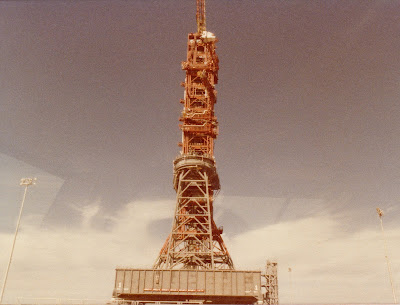
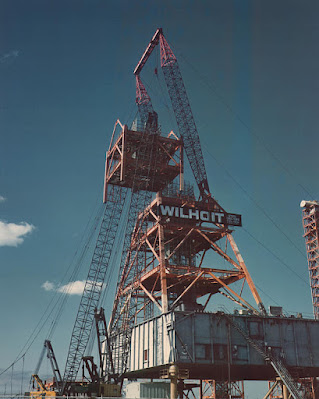

When I stood on the riverbank at Titusville in April of 1981 and watched STS-1, the first Space Shuttle launch, in the foreground was that Apollo Saturn V launcher that had been converted for the Saturn IB with the milk stool. It had been used for Apollo, Skylab and ASTP. Now it was parked behind the VAB, waiting to be scrapped – and years later it was. Somehow, its demise was symbolic of growing up with spaceflight in the 1970s. 

INSPIRATION

During that week and a half of the ASTP mission there was a news conference between the crew and President Ford. I missed it, but my brother captured it on my cassette tape. Later as I sat and listened to the tapes Deke Slayton was asked by the President what message he would pass along to America's school kids. His answer is 100% Deke...

"Decide what you wanna do, and never give up until you've done it."

I would be a high school senior in just a few weeks and that simple message from a man who had gone along a hard and frustrating dozen years to finally do what he wanted to do, resonated for me. I had already decided that I was going to attend the Embry-Riddle Aeronautical University and become a professional pilot. I couldn't afford it, it was known as the toughest aviation school in the world, and no one thought I could do it. Even my high school guidance counselor said flat-out that I couldn't do it. It took me a decade to work my way through that university, but on August 15, 1987 I proved them all wrong. Along the way I always remembered Deke's words, and I never gave up.
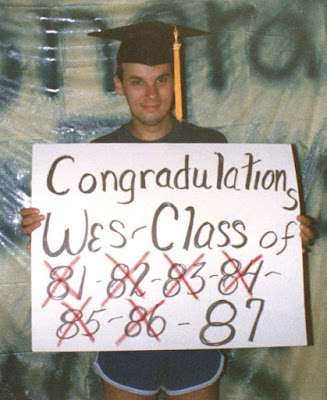
This sign was prepared for me by my mom and my wife-to-be.


Saturday, July 19, 2025

Apollo- Soyuz, as I lived it a half century ago Pt7


  SOYUZ RETURNS

After departing the company of Apollo, the Soyuz crew had a full day remaining in space. They were assigned some minor scientific tasks, but Leonov had an experiment of his own to conduct. Being a very accomplished artist he found that photos simply did not capture the stunning colors and beauty of the Earth below that his eyes had witnessed.

He had been allowed to bring, aboard Soyuz, what he described as "my crayons" some drawing paper and "a special device which allowed me to measure and record, very precisely, the colors of different parts of the surface of the Earth."

Leonov recalled in the book "Two Sides of the Moon" that he was able to capture the true deep blue color of the Black Sea. He wanted to do the same with the Earth's mountain ranges, but ran out of time. He had stated to Soviet space officials that his reason for taking the art supplies aboard the spacecraft was to enable Soviet cartographers to depict maps more accurately. In my opinion it was a great excuse for the artist cosmonaut to get his tools aboard the spacecraft and the stuffed shirts in the Soviet space bureaucracy bought it completely.

July 21 was reentry day for the Soyuz. In yet another of the mission’s over hyperbolized “firsts,” the public around the world, including the Soviets, got their first chance to see a Soviet spacecraft landing and recovery. Where I had spent the last seven years seeing Apollo’s descend on three parachutes (with the exception of Apollo 15 of course), the Soyuz was suspended beneath a single chute. I was getting ready for another historic day on the Civic Center’s labor crew and got to watch the landing before I left for work as retro rockets gave a brief burst to cushion the spacecraft’s contact with the ground. Frankly I was not really impressed by it as it seemed like an odd way to return from space. 

Of course to the Soviet people Apollos splashdown probably seemed overly complicated and odd too. Like everyone else who followed the American space program, I had no idea that one day our own NASA astronauts would be landing aboard Soyuz in the exact same manner. In fact such a thing was beyond anyone’s imagination. Frankly, we were sure that the only way that the Soviet Union would dissolve would be in the mutually assured destruction of an atomic war and as long as their closed society existed, there would never be a time when Americans would fly aboard a Soyuz. We could never have guessed that just 14 years later, the Soviet empire would simply crumble, the iron curtain would lift and open the way for our two peoples to live together aboard the same space station. Such was the stuff of Star Trek and science fiction- or so we thought in 1975.

Friday, July 18, 2025

Apollo- Soyuz, as I lived it a half century ago Pt6


DEKE FLIES APOLLO

Today it was Leonov and Kubasov’s turn to begin their return to Earth in the Soyuz, and my brother Craig was doing a great job recording their departure while I sat on the dock with my new amazing girlfriend. Undocking took place at 8:33 in the morning Windover Lake time on July 19th and Deke Slayton was finally able to pilot a spacecraft on orbit. 


It was April 2nd, 1959, when Donald K. "Deke" Slayton got the the phone call informing him that he had been selected to be one of the group of seven original U.S. astronauts. 


He had flown 1,431 hours and 63 combat missions in World war II and later countless hours as a test pilot for the Air Force before turning his skills toward a new organization called NASA. According to his book "Deke" he had known all along through the astronaut selection process that he would make the cut. When the announcement was made as to which three of the seven astronauts would fly first, his name was not on the list. He wasn't disappointed because a minor health ailment, other than his heart skipping a beat occasionally, had cropped up. Then later when he was grounded after being scheduled to fly right after John Glenn's mission, Deke's position as head of the astronaut office saw him flying with assorted other astronauts for more than a decade. Yet, he was never allowed to fly a spacecraft. By the way, it was Deke who had pushed to have the term "capsule" changed to "spacecraft" early in the Mercury program. 

Now, on the 19th day of July 1975 he finally got to hand-fly an actual spacecraft, (note: in "Deke" he states that it was Saturday the 21st of July- that Saturday in 1975 was actually the 19th.) Deke had practiced the maneuvers many times in the simulator thus now he backed Apollo off and then eased in to re-dock. Similar to Stafford's problem, the sun's glare was in Deke's eyes making it difficult to get the alignment. Additionally, a slight incorrect nudge in the hand controller and his correction caused a slight bump when contact was made and Soyuz shook a small bit as hard dock was achieved.

Dressed in their full pressure suits, in case something may go wrong and Apollo may crash into their Orbital Module, the two cosmonauts were seated in the Soyuz Reentry Module. Soyuz was a completely passive vehicle. The reason being that Soyuz 19 had a limited command and control capability, limited propellant reserves and very limited sighting alignment along the docking axis. So, her crew were just along for the ride. Apollo, on the other hand, had no such limitations having been designed to not only rendezvous and dock in Earth orbit, but also while on the way to the Moon and while in lunar orbit. It also had the capability to transition down from a high lunar orbit and go the rescue of a disabled lunar module.


Once the second docking had been done the two spacecraft were in range of Soviet ground stations and the crew could make a live broadcast down to the Soviet people. Thus, Leonov and Kubasov made their way back into the OM and did a show demonstrating how they made a meal in space. As soon as they were finished, they closed their hatch and fastened back into their couched in their DM awaiting the final undocking.


At 11:26am Windover lake time, with Deke's hands on the controls t
he two vehicles smoothly undocked and maneuvered so that the Apollo would blot out the sun and form a man-made eclipse that the Soviet crew photographed. Considering that the U.S. Skylab had just compiled enough imagery of the sun to keep the solar physics community busy for about two decades, this must have been our effort to allow the Soviets to catch up a bit. Otherwise it would have been nothing more than a pointless egghead exercise. Additionally, Deke did a scheduled fly-around Soyuz. Then he burned the Apollo's RCS thrusters to place the spacecraft in a position 1km above and behind Soyuz. Once out of range of ground stations, Stafford called Soyuz and asked how they were doing? Leonov answered that they were resting. Just then the Apollo crew played a cassette tape of girls giggling in the shower that Brand had brought along and told Soyuz that the Apollo crew were working hard. All jokes aside, Deke had done an amazing job of space piloting.

In Mission Control, the flight surgeon's readout showed a steady, flawless heartbeat from Deke Slayton's monitors.

Thursday, July 17, 2025

Apollo- Soyuz, as I lived it a half century ago Pt5


HUMMMM… WHAT TO DO?

Following Thursday’s historic docking and handshake in space I was scheduled to work a half-day on Friday. Thereafter I had a choice: I had the next two-and-one-half days off and I could either stay home in my room in the basement monitoring ASTP, or I could go up to the lake and spend time with my new girlfriend. 

Hummm… what to do? 

It was a choice that is rare for a space geek; either stay home and watch for spaceflight news snippets on the TV, or go up to the lake and be with a gorgeous blond babe. 

What would any all-American, red-blooded 17-year-old, die-hard space-buff do?

RIGHT ! And we didn't listen to "Sweet Home Alabama" all day long... we listened to Bad Company, (sorry Kid Rock.)

When I returned from up on the lake two-and-one-half days later, I did my best to catch up on the latest ASTP news. I had wanted to keep my tapes complete while I was gone and so I needed a member of the family to help. Mom was out of the question, referencing some of my “smart assed” behavior earlier in the mission. Dad was always working and my sister was preparing to dance on a local showboat. That left my 12-year-old brother; the one person I knew I could depend on.

Whenever I politely asked Craig to assist me in something like this he always did an outstanding job. Craig, even at age 12, was more savvy and dependable than 99 percent of the adults I had met. That was, of course, if I asked politely. If I ordered him like an older brother, the results were different. Once after a hockey game we were sitting in the Blue Line Club with friends and I demanded that Craig “Go get me a glass of water!” Moments later he showed up smiling with a cool glass of crystal clear water. I took a drink and he asked me if I liked it? I said that I did and he responded that he had gotten it out of the toilet.

So it was that I asked Craig, very politely, if he would help me and record the stuff from ASTP that I may be missing while I was up at the lake. He agreed to man my recording equipment in the basement while I was gone. The results were amazing! He captured moments that I would have otherwise missed and scanned all three networks for tidbits. Now there would be no gap in my ASTP tapes. I am proud to say that my brother and I have always been the best of friends. I just never order him to fetch me a glass of anything.

While I had been up at the lake I'd missed the real "heart" of the mission. On Apollo 8 the "heart" had been the Christmas eve broadcast live from lunar orbit. On Apollo 15 the "heart" had been watching the crew take samples at Elbow Crater with the LRV's camera broadcasting the view down Hadley Rille. Skylab's "heart" was having astronauts Conrad and Kerwin fix the jammed SAS wing during and EVA. Additionally, the "heart" was served up when the crew of SL-4 stuck it out for a world record in orbit. Now, ASTP's "heart" was a made for TV handshake followed by the exchanging of some politically approved trinkets. Up at the lake, I wasn't missing much.

Although much of the smiles and posing looked very contrived and practiced, which they actually were, Stafford and Leonov made it work.


The fact is that Stafford and Leonov, two military pilots from opposing ends of the cold war, became true life-long friends.
Leonov and Stafford messing with a docking simulator decades after ASTP.


No sooner had the first transfer of crew taken place than President Ford was on the phone to the orbiting crew. Due to a communications glitch that was haunting Soyuz, Slayton was asked by Mission Control to allow Leonov to use his Snoopy Ears headset so the the cosmonaut could hear the U.S. President.

Another aspect of the ASTP show was the fact that some of the photos were very candid. 

Here we see Stafford and Slayton having some squeeze treats. Leonov, having remembered a toast he gave back in 1965 in a small gathering of three astronauts and two cosmonauts where he said that some day they should gather together in space and have a drink, in preparation for ASTP he took two tubes of soup and had them marked "Old Vodka." Early in the ASTP orbital flight he and Stafford were scheduled to have a meal together. He handed Slayton the tube and basically said "a toast!" Stafford knowing that consuming booze in flight was a huge no-no, yet not wanting to offend his Russian friend, took a careful sip... expecting Vodka, yet getting soup. Deke once described the jokester Leonov as the Soviet's version of Wally Schirra.


Stafford, Leonov and Slayton show that you can fit three into the Soyuz Orbital Module... as long as one is half way into the tunnel to the DM. So... I guess it's really two and a half.

A very accomplished artist, Leonov shows off a pencil sketch of Stafford. Note, again, that he is wearing an Apollo "Snoopy ears" headset rather than the standard Soyuz headset.


Deke Slayton had been a major player in the U.S. space program, but somehow he found a form of personal validation by flying on ASTP. In the world of flying, those moments come to us all, yet they are always kept very private, although highly satisfying.

Whoever came up with this symbolic shield-like thing was likely quite proud to see it fly. The rest of us had a sort of, "what the hell is that thing" impression.

Here we see Kubasov signing another artifact. 

Mission Control as Stafford and Leonov give a news conference. Look closely and you can see just how non-intense Mission Control is at that moment.


The two days of joint operations which involved shifting and shuffling of crews, both astronauts and cosmonauts were in their respective spacecraft and the hatches were closed out by 4pm Houston time.

WATCH FOR PART 6


Wednesday, July 16, 2025

Apollo- Soyuz, as I lived it a half century ago Pt4


HAND-SHAKE

Thursday, July 17, 1975, was the historic day when a Soviet spacecraft would link up with an American spacecraft. I was lucky enough to be working an early morning half-shift that finished at 11:00 and gave me plenty of time to get home and watch the event. The networks were on the air starting at noon in an all-out effort to cover this rendezvous and docking.

In the late 1960s to early 1970s even the most rabid civilian space buff in the free world knew very little about the Soyuz and the Soviets were quite happy to keep it that way. Now, thanks to the Apollo Soyuz Test Project, that was all changed.

Soyuz consisted of three modules...

...a service module like Instrument-Assembly Module...

...a Reentry Module...

...and an Orbital Module.

One stand-out feature of Soyuz was that it operated by getting much of its electrical power from solar panels, rather than Apollo which used fuel cells.

Now, we western space-buffs were going to get to see the inside of Soyuz on live TV.        

Indeed, the whole world was watching. Presidents, First Secretaries, diplomats, reporters, spies, generals and just regular slobs like me were all watching the docking. Oddly, it was only the space-buffs who were scratching their heads and asking, “What’s the point?” Why was it that exploration and science in space was considered to not be newsworthy, but a common rendezvous and docking, something that the United States had been doing since 1966, was now hot global news? Indeed, we space-buffs thought that, but we still watched.

Soyuz was the passive vehicle in the rendezvous and Apollo was the active spacecraft. As the rendezvous proceeded, the people involved spoke to the people from the other country in that country’s language. Thus, Stafford spoke to Leonov in Russian and Leonov spoke to Stafford in English. It was a bit strange because when Stafford spoke a Russian translator took what the astronaut was saying and gave it to the U.S. audience in English with a Russian accent. Of course, the same was true for Leonov, only the Soviet public probably got an Oklahoma accent.

As the two spacecraft captured in a hard dock Leonov sang out that Soyuz and Apollo were “shaking hands.” We saw cut-away video of the space centers in Russia and the United States with controllers standing and applauding. At that moment my thoughts were of Deke Slayton. Even as a 17-year-old I knew what he had been through. He had been forced to sit in Mission Control for more than two dozen dockings in space while wishing he had been on every one of them. This time it was everyone else in Mission Control watching him. It is rare that a very large wrong is made right in such a public way. I wondered how many of those people in Mission Control were applauding as much for Deke as they were for ASTP.

Docking was achieved by way of an androgynous docking collar attached to the Soyuz and the forward end of the DM. The aft end of the DM had the standard Apollo drogue/probe unit.

The probe in CM 111 was actually the same probe that was used on Apollo 14. Normally, Apollo CM vehicles jettisoned their probe with the Lunar Module's ascent stage. Because Apollo 14 was the first mission to have problems with docking capture on the way to the Moon, NASA had their probe mechanism retained and returned for engineers to study in order to seek out what the problem may have been. They found nothing, so the probe was reused for ASTP.

Other than the docking adapter, the only other new piece of spaceflight hardware for ASTP was the DM.  It was required because the Apollo CM started on the pad with a sea-level atmosphere which was a nitrogen-oxygen mixture. As the Saturn booster ascended, that cabin was vented down to 1/3 sea level, pure oxygen. This was a direct result of the Apollo 1 fire which was fueled by pressurized pure oxygen. The Soyuz, however, flew with sea level nitrogen/oxygen atmosphere. If the Apollo astronauts had been exposed to that, they would be forced to spend a long period after each exposure slowly purging nitrogen from their blood to avoid something similar to "the bends." Thus, the Soviets also agreed to reduce the Soyuz atmosphere to just 2/3 sea level. The DM allowed the crews to make the transition in an air-lock environment that was good for both sides. The DM was designed and constructed by Rockwell International Space Division.

Three hours and five minutes after the capture, Stafford and Slayton in the DM, closed the hatch to Apollo and allowed the atmospheres to adjust, then opened the hatch to Soyuz on live TV. In the distance through the adjacent tunnel we could see the two cosmonauts moving inside the Orbital Module (OM) of the Soyuz. There was a communications glitch that would haunt the entire duration of the docked activities and we could not hear the cosmonauts speaking at first. After a short delay, Leonov floated into the tunnel and he and Stafford shook hands in a very contrived manner as they exchanged happy greetings that gave you the impression that the words were printed on a note card. A moment later Slayton also floated into the camera’s view and shook Leonov’s hand. It was all highly symbolic, well scripted and made for the cameras.

Eventually Stafford floated through the tunnel and into the Soyuz OM. And then the TV switched from the American feed to the Soviet feed from the repaired equipment aboard Soyuz. The Russian ground technician who had installed that camera must have sighed with relief; there would probably be no trip to the salt mines for him. He may simply be reassigned to polishing railroad rails for a living.